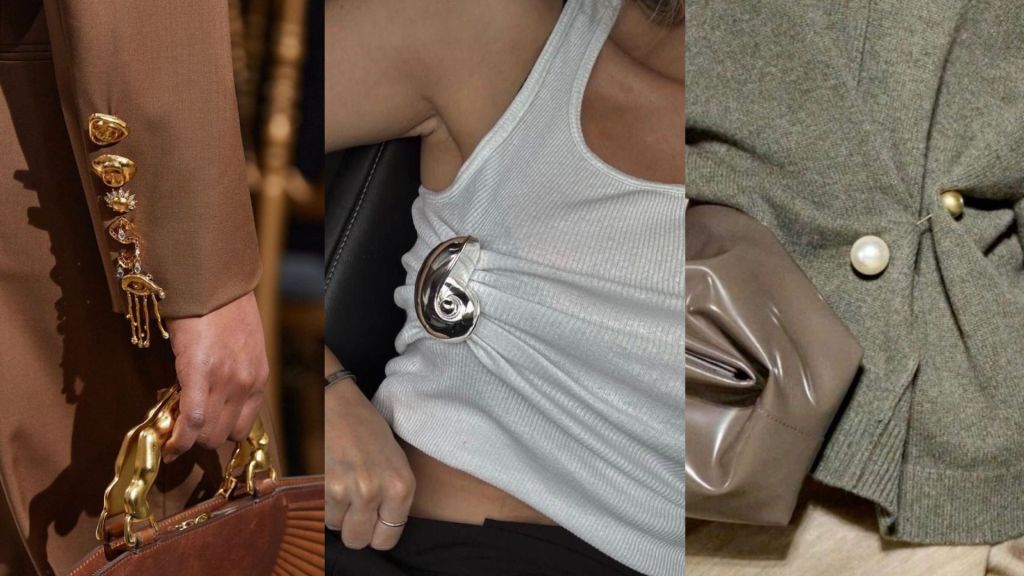
From embellishment to garment creator. How a brooch can create new pieces from the ones you already own.
Soundtrack of this piece:
When I think of brooches, I think of my grandmothers. And I know what you might be thinking.
Démodé? I promise you: absolutely not.
The brooch is one of the oldest, most versatile objects we have ever used. It began as pure function. A way to hold fabric together. And, over centuries, became something else entirely: a marker of status, a piece of art, a personal signature, a fragment of family history passed down without words.
In my opinion, it is one of the best examples of what a luxury object truly is: not only something useful, but something meaningful. Something that goes beyond utility and touches identity, belonging, and memory.
But that layer of meaning came later.
Like everything in life, brooches were born out of necessity. Out of the simple need to hold together the garments we had just begun to wear. And in doing so, they gained something more. Not only the ability to sustain, but, in my opinion, the ability to create.
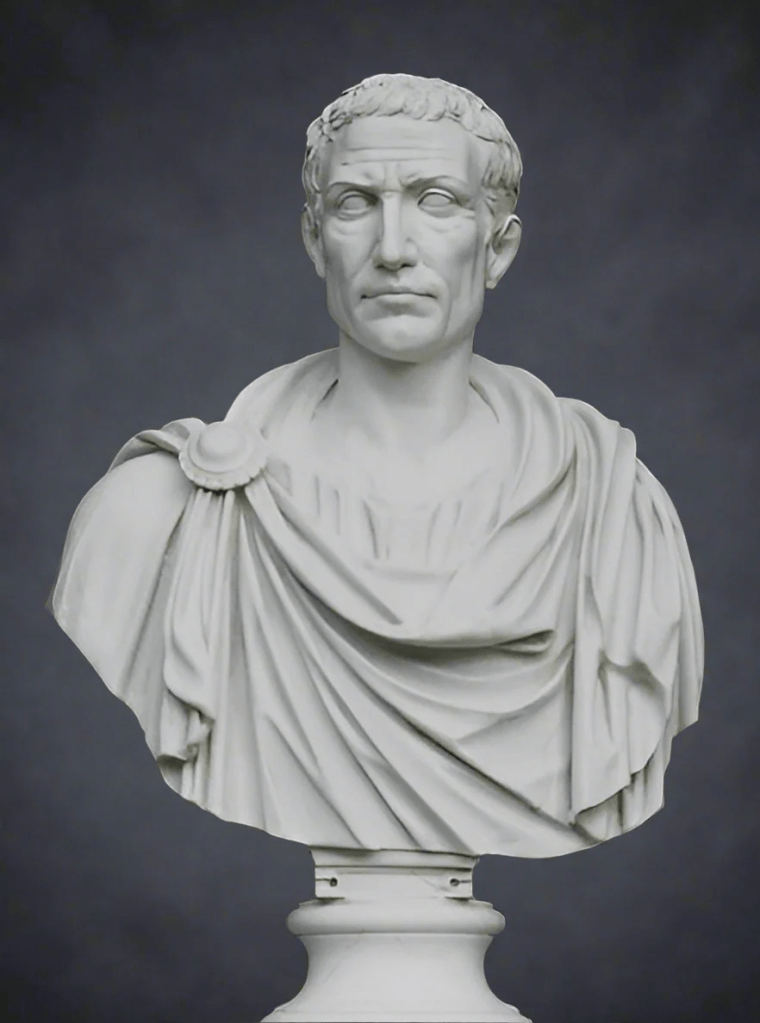
This shift happens the moment buttons appear, taking over what had once been the brooch’s original role as a holder: the fibula. Yes, the ancestor of buttons. For thousands of years, these ornaments were much more than decorative. Emperors, patricians, plebeians, slaves, everyone used fibulae. And if you look closely at ancient busts and statues, you can still see them there, holding garments together.
Worn at the court of Louis XIV, it entered the world of jewellery becoming an ornament. The brooch crossed then an invisible line. It stopped being something you needed and became something you chose. An accessory. A finishing touch. And we forgot what this object is actually capable of; not only embellishment, but creation. Reshaping a garment, changing a silhouette, inventing a neckline, turning a piece you have worn a hundred times into something that suddenly feels different again.
It draws us back into a different relationship with our wardrobe, where transformation matters more than replacement, and play replaces accumulation. Slowly, our wardrobe becomes something personal. Our alchemic wardrobe.
Before a brooch can transform a garment, it has to be chosen.
On choosing a brooch
Inherited stories
Sometimes, they come through inheritance. Passed down from a grandmother, an aunt, a woman whose style we absorbed long before we understood it. They carry emotion, memory and family histories. Wearing them is never neutral. Beyond beauty, they quietly carry the presence and strength of the women who shaped us.
A rare encounter
Other times, the brooch is found. In a brocante or a flea market, where intuition guides the eye more than intention. A piece you were not looking for, but instantly recognised, almost as if it had chosen you. It comes with its own story, sometimes known, sometimes unknown, and becomes part of what you wish to express to the world.
For those drawn to a more classic or vintage language, these pieces naturally become allies.
Contemporary silhouette shapers
Others will feel closer to contemporary brooches, designed today with modern proportions and lighter materials, conceived not only as ornaments, but as true silhouette-construction tools.
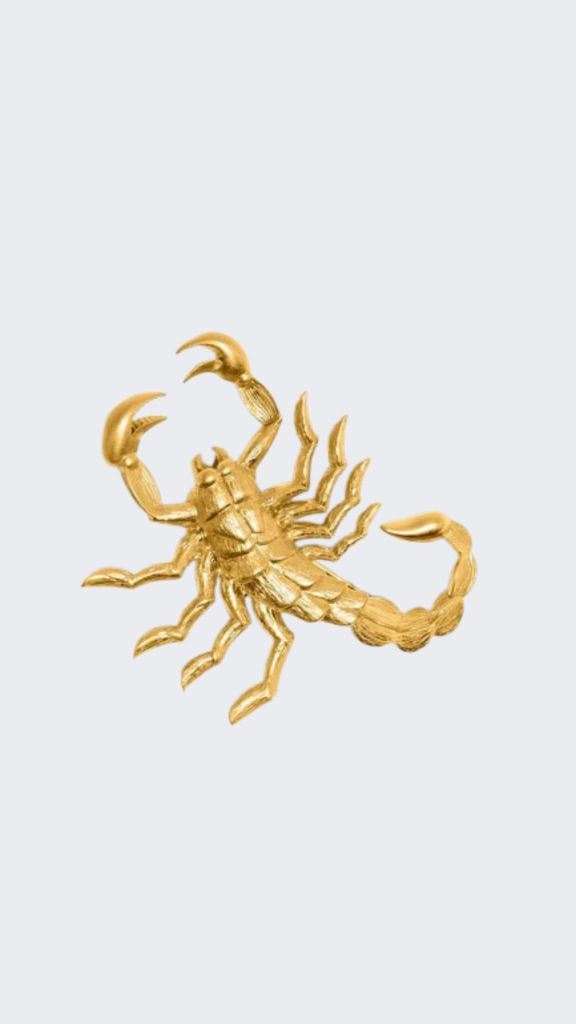
At the most expressive end of this approach stands Schiaparelli, where the brooch becomes pure statement, suspended between surrealism and beauty at its most theatrical. The maison is exceptionally precise in its dialogue between materials. Soft fabrics are constantly confronted with harder, sculptural elements. This constant play between the fluid and the solid is precisely what makes Schiaparelli, in my view, the most relevant reference when we think of brooches as silhouette creators rather than only decorative accents.
For those who, like me, feel undeniably drawn to astrology and its mysticism, the maison’s zodiac collection is particularly captivating.
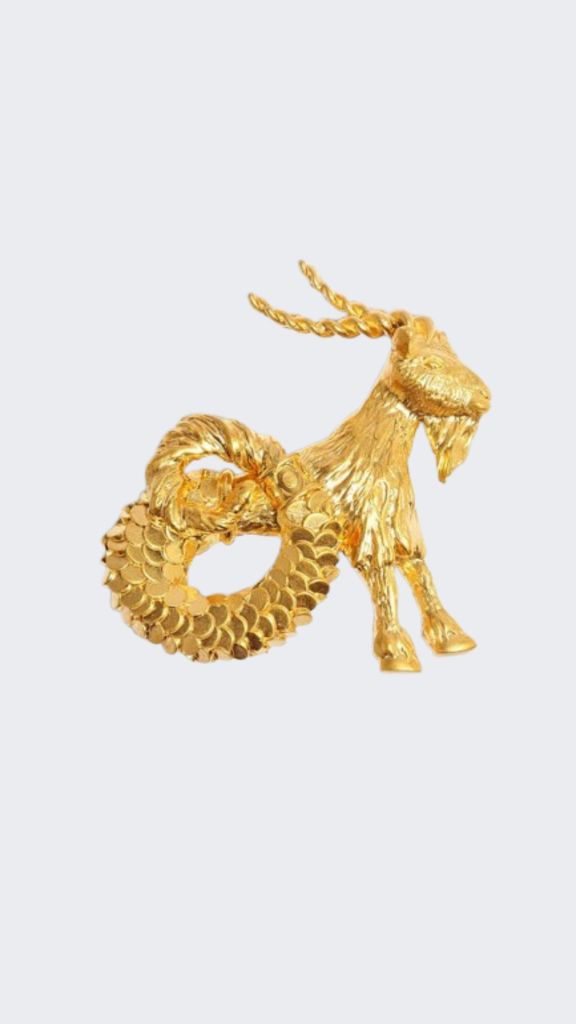
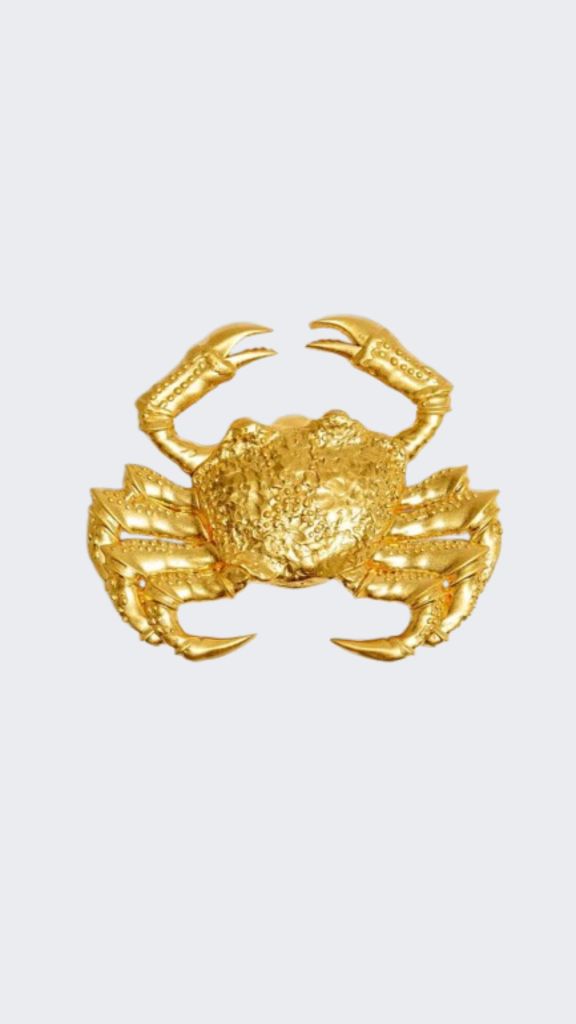
A more accessible entry point is offered by Alighieri, whose talismanic pieces, inspired by Dante’s Divine Comedy, speak to a raw and symbolic idea of beauty.
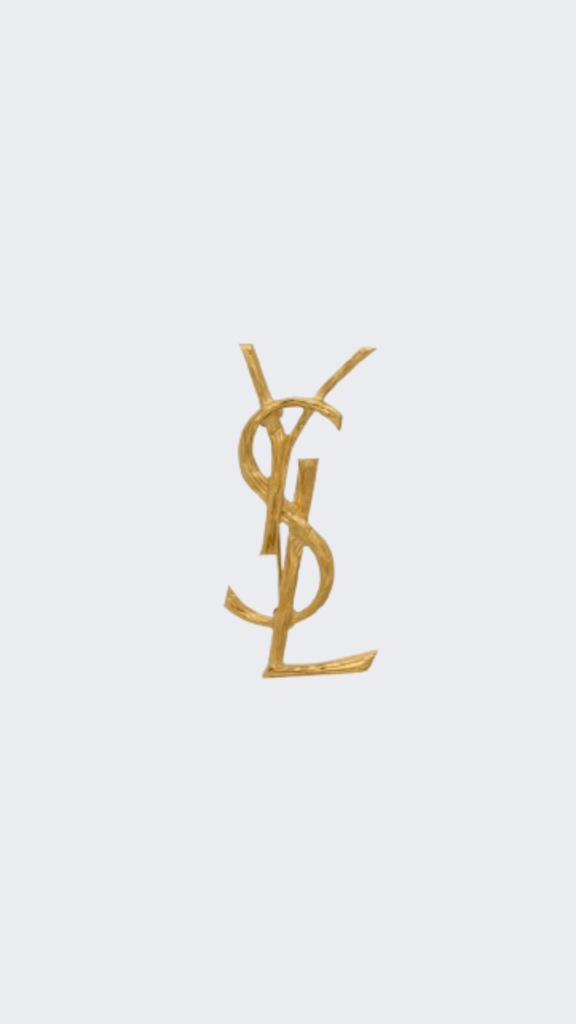
This sensitivity to symbolism is precisely what led me to my own choice. I did not have the chance to inherit a brooch from the women of my family. But during my years at Saint Laurent, I instinctively knew that buying one would be a meaningful investment, even if I could not yet explain why. There is something about the Cassandre, designed by Adolphe Jean‑Marie Mouron, that feels less like a logo and more like a small work of art you happen to wear.
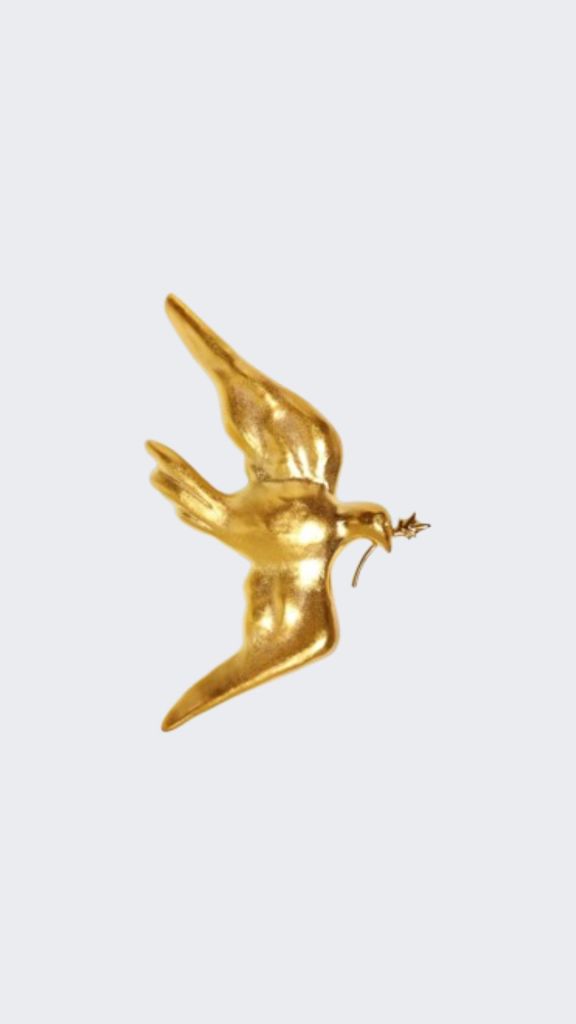
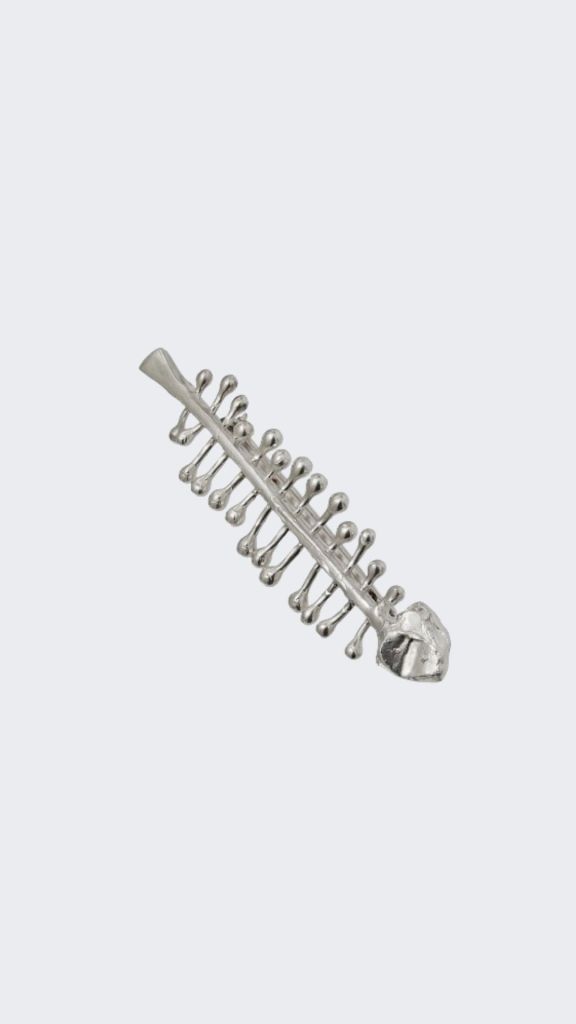
Here are a few of my favourite brooches. You can select any image to discover more about each brand and its creations.
So I began to explore, almost instinctively, how a single brooch could change the way my garments behave, giving new life and a fresh perspective to pieces I once loved but had grown bored of.
And just like that, my YSL brooch became my main tool to turn a wardrobe built around basics into something more contemporary, more sophisticated, and ultimately, more like me.
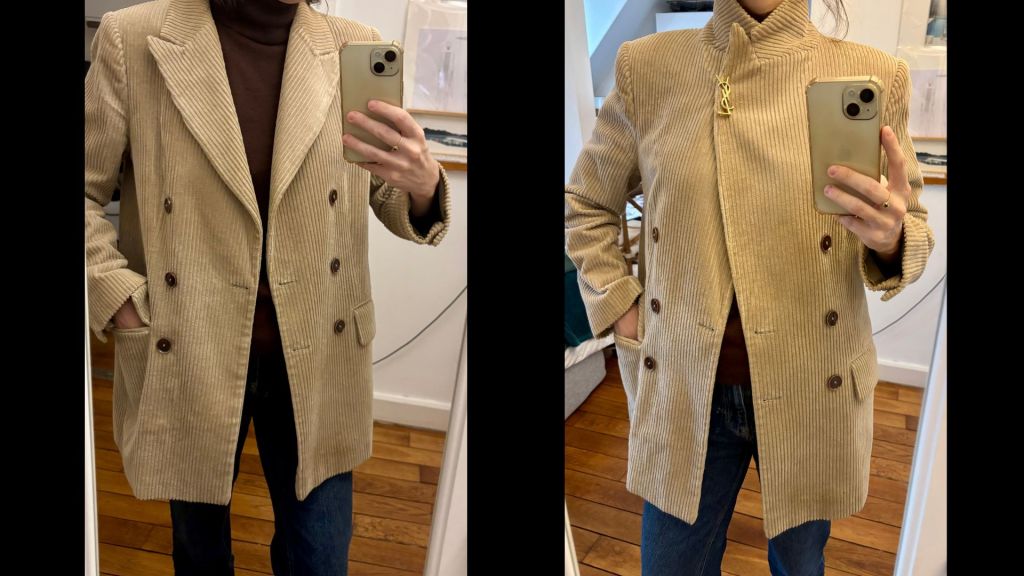
Turning a classic blazer or coat into a funnel-neck silhouette
By closing the lapels or front edges higher on the chest and fixing them with the brooch, the coat gains a new collar line. The opening is lifted, creating a funnel or stand-neck effect.
Here, the brooch replaces the function of a button or hook and subtly changes the posture of the garment.
In doing so, you recreate the now iconic funnel-neck blazer, a silhouette popularised by Armani and widely reinterpreted by many other brands, including Zara. This shape has quickly become one of the favourites among industry insiders and fashion content creators, precisely because it transforms a classic tailored piece into something sharper, and more architectural.
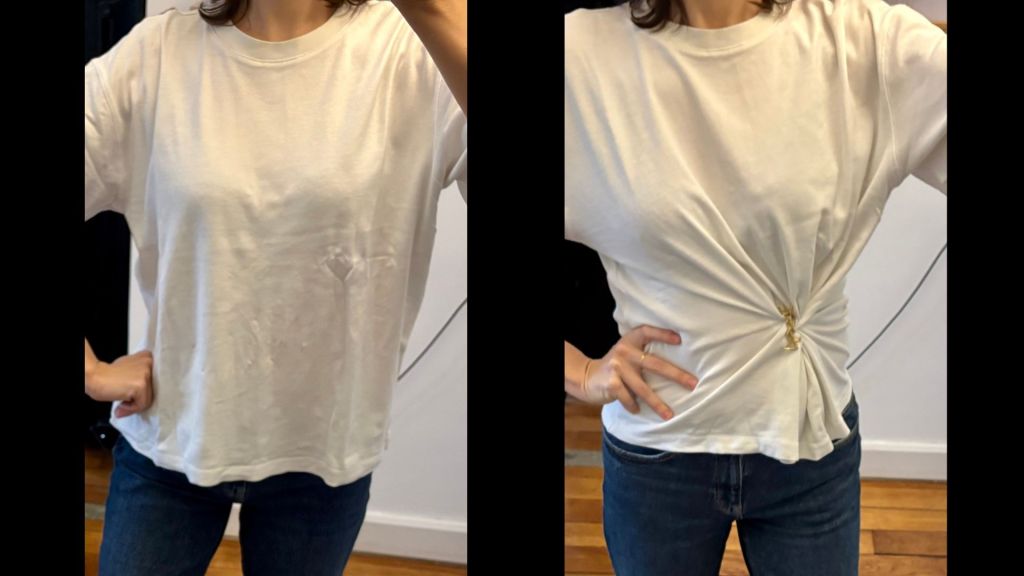
Rebuilding the T-shirt through a central twist
On a simple T-shirt, the brooch is placed slightly off-centre at the waist, gathering excess fabric into a controlled twist. This single point of tension redraws the volume of the garment. The result is not only more fitted, but visually structured.
The brooch becomes the anchor that creates drape, asymmetry and movement, turning a flat basic into a constructed top.
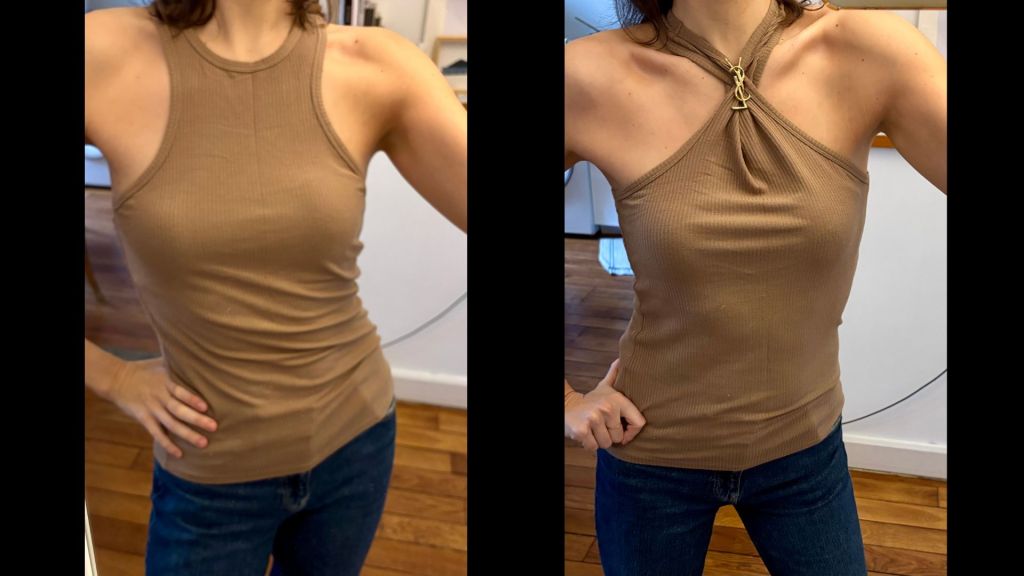
Creating a soft twisted neckline top
By bringing two sections of fabric from your tank top to the centre of the chest and fixing them with the brooch, the neckline is lifted and softly wrapped around the neck, creating a more sophisticated halter-style silhouette. You can literally wear the same tank top during the day and transform it into a refined evening look for an improvised dinner.
If you would like to go further, you can join the Sardina’s Tales community on Substack, where I share additional examples, photos and hands-on techniques.
A brooch does not change a garment on its own. It changes the way we look at what we already have.
What began, for me, as a simple object, an investment, became a way of transforming without replacing. Allowing my quality pieces to evolve with me, instead of leaving them behind.
This is what an alchemic wardrobe truly is. Not a system. Not a method. But a relationship.
 Sardina's Tales
Leave a comment